
A Handcrafted Mirror for a Hotel Welcome: Designing with NAVADO Flying Clouds
Imagine arriving at a small hotel and seeing one carefully composed mirror beyond the reception desk. It catches the light, but its frame also has a presence of its own. That is a useful starting point for a UK or European hotel brief: choose the view the guest will meet first, then design the wall around it.
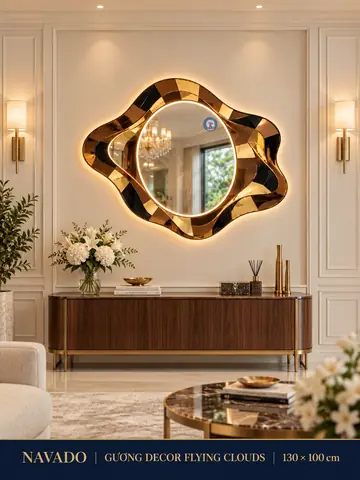
The NAVADO image below is an illustrative interior photograph, not a completed hotel installation. The same planning questions apply whether the proposed location is a reception area, a lounge or a corridor.
Begin with the arrival sightline
Stand at the entrance and look towards the proposed wall. Sketch the outline of the reception desk, doors, lamps and signs. Decide whether the mirror should sit on the centre line of the desk or anchor a quieter seating corner. Check what it will reflect from both standing and seated positions: a considered view of a window, artwork or warm material can be more useful than a reflection of a busy service counter.
The NAVADO Flying Clouds mirror measures 130 × 100 cm. Mark that rectangle on the wall with removable tape. Leave enough space around it for the sculptural outline to read independently of nearby signage and lighting. Its width can suit a broad feature wall, but the actual furniture and circulation space should decide the final position.
Let the glass colours set the rhythm
Flying Clouds uses a frame assembled from gold, bronze-toned and black mirror glass, with backlighting described in the NAVADO catalogue. Rather than repeating all three colours throughout the room, choose one to echo in a nearby detail. Bronze-toned glass can sit alongside warm timber; a small black accent can give the composition definition. Compare finish samples under the actual reception lighting before settling on the palette.
Think about light in layers. Check the reflection in daylight, then again with the evening scheme on. Ask where the backlighting will be powered and how it will be accessed for maintenance. Keep a separate light source for the work at the desk; the mirror's glow is part of the atmosphere, not a substitute for task lighting.
Make the handwork visible without crowding it
The frame's effect comes from individually arranged and finished mirror pieces. Their edges and joins catch light at different angles, so the sequence matters as much as the choice of colour. In a proposed bespoke version, share a straight-on wall drawing and discuss the proportions of the frame, the direction of the pieces and the finish at the meeting points. A sample can help the designer judge how those details look at the distance from which guests will normally see them.
For a smaller wall, compare the Sophia framed mirror, 60 × 80 cm. Its hand-assembled bronze mirror-glass frame offers a simpler rectangular rhythm. Use paper templates at both sizes before deciding which gives the wall room to breathe.
Turn the idea into a practical brief
Send NAVADO the wall dimensions, a photograph from the entrance, the proposed mounting height, nearby finishes and the location of any power supply. Ask for the final dimensions, weight, fixing method, electrical requirements and finish to be confirmed for the chosen design. For an overseas project, agree the packing, transport, taxes and installation responsibilities in a written quotation before placing an order.